
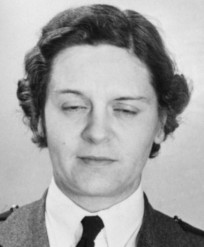
| Rank | Lieutenant |
| Service Number | NFX76284 |
| Unit | 2nd/13th Australian General Hospital |
| Cause of Death | Murdered as a POW of Japan in the Bangka Island massacre |
| Place of Death | Bangka Island, Indonesia |
| Date of Death | 16 February 1942 |
| Age | 34 |
History
Ada Joyce Bridge (known as Joyce) was born on 6 July 1907 in Scone, NSW. She had an older brother and was the daughter of William Thomas Bridge and Ada Matilda Bridge (née Thurlow). William was a descendant of Joseph Bridge, a convict from Lancashire, England who arrived in NSW in 1806 on the Fortune. Joyce’s family home was ‘Stoney Creek’ in Belltrees, about 30 km from Scone.
As a young girl, Joyce loved the country life at Stoney Creek. She and her brother rode their horses about 5km to the public school at Belltrees until they reached 6th class. The outdoor life tanned her skin and emphasised her brown eyes and short brown hair. Those who knew Joyce at this time described her as a happy girl, who enjoyed her life to the full.
She had a ready smile which often turned into an infectious chuckle…… She was not very tall, but her figure was slim; her arms were strong and her hands were gentle……Joyce was socially very popular, and being an excellent dancer, she enjoyed the local dances.’ ‘. (p5 One Life is Ours….)
She applied to St Luke’s Hospital at Darlinghurst Sydney, was accepted as a trainee nurse and commenced on 1 February 1930 and graduated in 1934. She sat for her Nurses Registration Exam on 23 May 1934 and passed all subjects.
A friend who graduated with Joyce remembered her “as a very pleasant companion, very bright with a great sense of humour. She was a genuine friend, a typical country girl who took pride in her work and was very good nurse.” (p8 One Life is Ours….)
She left St Luke’s some time after graduation and joined the Toshack’s Nursing Club based in Kings Cross Sydney and undertook private nursing. During this time she shared flats in the area with a number of her colleagues from St Luke’s.
Joyce came from a very patriotic family and enlisted in the Australian Army Nursing Service on 8 April 1941 and was called up 19 August 1941. She was posted to the 2/13th Australian General Hospital (AGH) and travelled to Singapore aboard the Australian Hospital ship Wanganella arriving on the 15 September 1941.
Initially, Joyce and nine other sisters were attached to 2/10 AGH at Malacca in Malaya, where they stayed for three weeks. But life was not all nursing and hard work. ‘Joyce and her friends found new and enjoyable off-duty activities; shopping in the village, sampan picnics, golf, swimming and tennis, as well as the usual social activities in the sister’s mess. She enjoyed her work in the wards, gaining experience of nursing in the tropics and becoming acclimatised’. (p15 One Life is Ours….)
All ten sisters then returned to Singapore to commence work at 2/13 AGH, which was located at St Patrick’s School. Between 21-23 November 1941 the entire hospital was moved across the Strait to Tampoi Hill on the southern tip of the Malay Peninsula. However, due to the swift progress of the Japanese invasion force, most of the hospital staff was evacuated back to Singapore in late January 1942.
She survived the sinking of the “SS. Vyner Brooke” but tragically was amongst the nurses massacred on Radji Beach (On Radji Beach p. 218).
A small book was written in 1989 by Joan Crouch entitled “One Life is Ours: the story of Ada Joyce Bridge”. The local newspaper in 1954 described her as “ … a popular and brave district servicewoman …” and on 27 May 1954 The Scone Advocate published an article about the dedication by the Scone & District Country Women’s Institute of its new Baby Health Centre and Assembly Hall, “ … with all conveniences in Kelly Street, part of the land on which the Cottage stands ( facing Kingdon Street) …”, to Joyce Bridge with a most warm description of her “ … To those who knew her in private life there remains the memory of a lovely girl with laughing brown eyes, unafraid to face the horrors of war in her eagerness to help nurse the wounded and suffering …”.
In the Forward to One Life is ours…. Vivian Stratham (Bullwinkel) wrote “When approached to write a Forward…., I felt very privileged.
‘I met Joyce, as we knew her, for the first time when our Unit… formed in 1941 and posted overseas to Malaya. The Unit had a short but intensive life during which the weaknesses and strengths of individuals were quickly recognised.
It was during this time that our respect, esteem and affection grew daily for Joyce’s commitment, skills and dedication. Joyce faced every crisis with cheerfulness and fortitude.’
‘One cannot but feel resentment and so very sorry that such a young, lovely and defenceless Australian Nurse, wearing a Red Cross Armband, was murdered in such a cruel and calculated way. A young woman who had so much to give the community and humanity….”.
A very fitting tribute to a lovely Australian country girl.
Today the baby centre has been absorbed into the wider medical facilities of the town of Scone, but the Country Women’s building remains where a portrait hangs of Joyce Bridge. Sadly the original medals issued to her posthumously which hung in the Assembly Hall were stolen some years ago, but have been replaced with miniatures.