
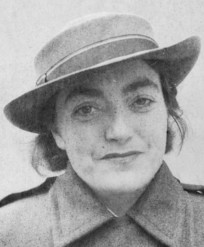
| Rank | Staff Nurse |
| Service Number | WFX11175 |
| Unit | 2/13th Australian General Hospital |
| Cause of Death | Shot by Japanese soldiers on Radji Beach |
| Place of Death | Bangka Island, Indonesia |
| Date of Death | 16 February 1942 |
| Age | 29 |
History
Alma May Beard was born on 14 January 1913 in Culham, Toodyay district, in Western Australia’s Wheatbelt region. She was the daughter of Katherine Mary Brennan (1883–1960) and Edward William Beard (1883–1966), who were married in Toodyay in 1907. She had four siblings, John (1908–1910), Kathleen (1909–2004), Arthur (1910–1983) and Doreen (1917–2012). The children grew up on ‘Pell Mell’, the family farm in Culham. The property may have been connected with Pell Mell School, which closed in 1900 and was located in the same area.
As a younger child, Alma attended Bejoording State School. In December 1920 the school concert was held at Culham Hall, during which, according to the 11 Dec 1920 edition of the Northam Advertiser, “the children of the school reflected the greatest credit on their teacher and their parents.” Alma took part in ‘The Wishing Well’, a “very pretty cantata,” while her brother, Arthur, took part in a chorus recitation named ‘The Railway Train’. Her sister Kathleen read one of ‘The National Poems’, which “were splendid and stirred up all the patriotism of the audience.”
While at school, Alma demonstrated an aptitude for sport. At the Bejoording School Picnic held in October 1924, she came first in the Girls Under 11 race and consistently finished strongly in running events held at the various children’s picnics and parties she attended around this time. She reportedly also loved to ride horses and entered dressage events at the Toodyay Show. In October 1925 she won first prize in the ‘any piece of work’ category in the ‘one-teacher school’ class at the Toodyay Show.
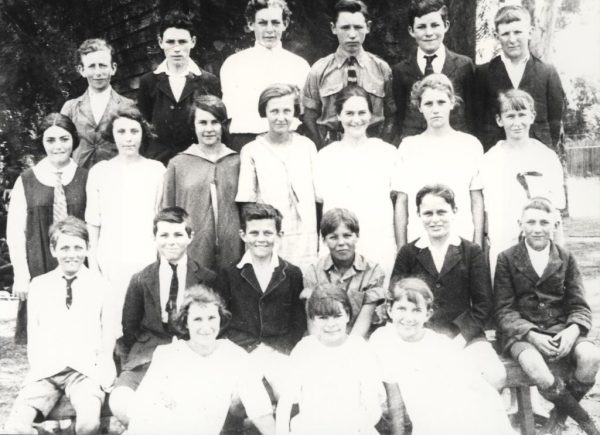
Alma finished at Bejoording State School and began attending Toodyay State School, on Duke Street in Toodyay’s town centre. There is a splendid photo of Alma and her class dating from 1926 in the Shire of Toodyay’s collection (and as shown below). In November 1927 Alma participated in the school’s Children’s Ball, held at the Toodyay Town Hall, during which the children spent a good deal of time dancing in sets. Six weeks later, the school’s annual distribution of prizes took place at the Town Hall. Alma was awarded the Most Popular Girl in the School prize – quite an honour – as well as the Grade VII General Proficiency prize. The prizes were awarded by A. Hodgkinson, chairman of the School Board.
After finishing primary school, Alma reportedly moved to Perth to board at Mercedes College, a Catholic school founded in1846 by the Sisters of Mercy. She is said to have returned home after a year at the age of 17. Interestingly, of the 65 Vyner Brooke nurses, Alma was one of only a handful of professed Roman Catholics. Irene Drummond, Jean Russell and Chris Oxley were three more, and there will doubtless be three or four others. Church of England adherents dominate, followed by Methodists and Presbyterians.
Sometime around the mid-1930s, Alma decided to be a nurse, and began her training at Perth Public Hospital. She became registered on 5 April 1939. Shortly after 20 September 1940 she relocated to New South Wales where she worked in one of the larger Sydney hospitals to gain additional experience.
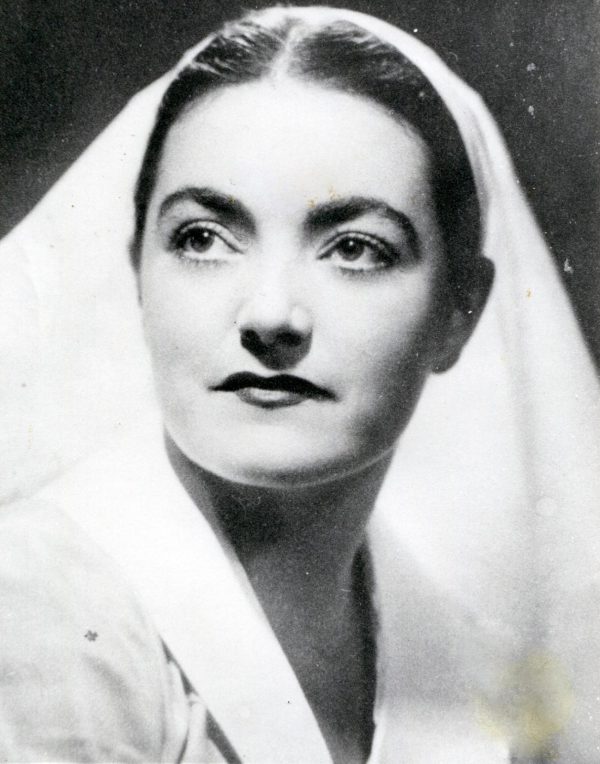
On 19 June 1941, having returned to Perth, Alma enlisted in the Australian Army Nursing Service (AANS). On 4 August she was called up for full-time duty and posted to the camp hospital at Northam, 30 kilometres southwest of Culham. Then, on 14 August, Alma was seconded to the Second Australian Imperial Force (2nd AIF) and the following day attached to the 2/13th Australian General Hospital (AGH) for deployment overseas. Meanwhile, she was posted to the 110th AGH in Perth (also known as Perth Military Hospital). At the 110th AGH she likely met Minnie Hodgson, Vima Bates and Iole Harper, fellow AANS volunteers who had been attached to the 2/13th AGH. All four would be on the Vyner Brooke together six months later.
On 6 September, three days before their departure, Alma, Minnie, Vima and Iole, together with additional 2/13th AGH colleagues Sara Baldwin-Wiseman, Eloise Bales and Gertrude McManus, were guests of honour at a morning tea arranged by the Sportsmen’s Organising Council for Patriotic Funds and held at the Hotel Adelphi in Perth. Lieutenant-Governor Sir James Mitchell presented each nurse with an initialled rug to mark their impending embarkation. Five other AANS nurses, Frances Aldoun, Betty Brooking, Evelyn Hardwick, Beanie Keamy and Gwen Martin, were also present at the tea, along with Matron M. D. Edis, Principal Matron (Western Command), who thanked the Sportsmen’s Council for arranging the function.
On 9 September, Alma and her six new colleagues boarded the Australian hospital ship Wanganella to joined 42 other AANS nurses of the unit, who had boarded in Sydney and Melbourne. After leaving Fremantle they were told officially that they were bound for Malaya, though no doubt many had already guessed.
On board, the nurses “spent their time lecturing the orderlies in bandaging and demonstrated some basic nursing procedures. They [attended] lectures on tropical medicine and [looked] after the Sisters’ Sick Bay on a roster system. They also enjoyed the entertainment on the ship as well as making new friends and getting to know the members of their unit” (Crouch, p. 13).
The Wanganella berthed at Victoria Dock on Singapore Island on 15 September. Upon disembarking, Alma and 38 of her 2/13th AGH colleagues were transported by bus to a requisitioned Catholic boys’ school, St. Patrick’s, located in Katong, on the coast around 10 kilometres east of the docks. St. Patrick’s School consisted of three large buildings, two of which were brick, and many smaller outbuildings. The beautiful grounds contained plantings of hibiscus, bouvardia, frangipani and gardenia. Alma and her colleagues were allocated pleasant quarters with wide balconies.
Meanwhile, the remaining 10 nurses of the 2/13th AGH had been told while still aboard the Wanganella that they had been detached to the 2/10th AGH. The 2/10th had arrived in Malaya on 18 February on the Queen Mary and had established a hospital in Malacca, an old town on the west coast of the Malay peninsula. The 10 were taken to the train station at Singapore, where they entrained for Tampin on the peninsula before transferring to vehicles for the trip down to Malacca.
St. Patrick’s was only a temporary base for the 2/13th AGH while the unit awaited the readiness of their permanent site, a section of a working psychiatric hospital in Tampoi in southern Johor state. In the interim, the 2/13th nurses were detached on a rotational basis either to the 2/10th AGH, as we have seen, or to the 2/4th Casualty Clearing Station (CCS) to gain knowledge of tropical nursing from their more experienced colleagues. The 2/4th CCS, like the 2/10th AGH, had embarked on the Queen Mary and had recently moved into the same Tampoi hospital earmarked for the 2/13th AGH.
Meanwhile, life in Singapore was very pleasant for the Australian nurses. They were feted by Singapore’s British expat community, taken on sightseeing tours, and invited to dinners, dances and tennis. They were made honorary members of the famous Swimming Club.
Alma was detached to the 2/4th CCS on 13 October and arrived at Tampoi the following day. She found a rambling, single-story complex of concrete buildings on the edge of the jungle, far from the hustle of central Singapore. According to her 2/13th AGH colleague Mona Wilton, the only noises were “the wind in the trees and the jungle birds singing to us” (quoted in Angell, p. 43). Another colleague, Jessie Simons, on the other hand, notes that the nurses “were often subject to the queer noises of the mental patients quartered in the remainder of the hospital” (Simons, p. 3).
Alma remained with the 2/4th CCS for just over five weeks. On 23 November the 2/13th AGH moved in, and the 2/4th CCS moved out, to a hospital at Kluang aerodrome, 100 kilometres to the north. Alma, remaining at Tampoi, rejoined her unit. The 2/13th AGH expanded and further equipped the hospital to a capacity of 1,200 beds. Before too long, every bed would be needed.
On 8 December the Japanese 25th Army invaded Malaya. An amphibious assault on northern Malaya was followed a few hours later by the bombing of Singapore Island. In Tampoi the nurses could see Japanese planes flying overhead, seemingly immune to British anti-aircraft fire. They could hear Japanese bombs exploding.
The Japanese army surged down the Malay peninsula, forcing British and Indian troops to withdraw southwards. In mid-January the 2/10th AGH was forced to relocate to Singapore from Malacca, the first of the three AANS-staffed medical units to move back to the island. On 19 January the 2/4th CCS began retreating southwards. Then, on 25 January, the 2/13th AGH was evacuated back to St. Patrick’s School at Katong.
The Japanese advance was unstoppable. An Australian offensive in January achieved little, and by early February the last Allied troops had crossed Johor Strait to Singapore Island and had blown up the causeway behind them. Despite strong opposition from Australian troops, on 8 February Japanese troops crossed Johor Strait and established a bridgehead. Singapore was doomed.
By now St. Patrick’s was by now so overcrowded with wounded combatants that outbuildings and even tents were used as wards. Casualties lay closely packed on mattresses on floors or even outside on the lawns. From outside the school came the constant noise of artillery fire.
On 9 February, in response to Japanese atrocities in Hong Kong, Major General Gordon Bennett ordered the evacuation of the 130 AANS nurses in Singapore. Unsurprisingly, the nurses did not want to leave hundreds of wounded patients in the lurch and refused to volunteer. In the end, Alma and her colleagues had to be ordered to leave by the senior matron in Malaya, Olive Paschke of the 2/10th AGH. Many nurses wept as they went about their work on these final days in Singapore.
Six AANS nurses left Singapore on 10 February and 59 more left the following day, including Alma’s fellow Western Australians Sara Baldwin-Wiseman, Eloise Bales and Gertrude McManus.
On Thursday 12 February, Alma and her remaining 64 colleagues embarked on the Vyner Brooke and in the gathering dusk steamed slowly out of Keppel Harbour. As the ship departed, several of the nurses looked back at the waterfront to see a city ablaze.
Between Thursday night and Saturday morning, the Vyner Brooke made its way slowly and without incident through the many islands that line the passage between Singapore and Jakarta, the ship’s destination. Then, at around 11.00 am on Saturday 14 February, the ship was strafed by a single Japanese aircraft, seemingly out of the blue. Three hours later, at the entrance to Bangka Strait and around 10 kilometres from Bangka Island, the Vyner Brooke was bombed. It began to list to starboard and sank within 30 minutes.
Somehow Alma made it to shore, most probably in one of the two lifeboats that reached land late on Saturday night in the vicinity of Radji Beach. She joined a large group of AANS nurses and civilians around a bonfire on the beach. Later, more survivors of ships bombed by Japanese forces – which, at that moment, were taking Sumatra and Bangka Island – reached shore and joined the party on Radji Beach. Among the group were many wounded.
Sunday passed by, and on Monday it was decided that the group should surrender en masse to Japanese authorities. A deputation left for the nearest large town, Muntok, to negotiate this. A short while later most of the civilian women and children of the group followed behind.
The Australian nurses were duty-bound to remain with the wounded on the beach.
Around mid-morning the deputation returned with Japanese soldiers. The soldiers separated the survivors into groups. They took the men around a bluff in two groups and proceeded to shoot and bayonet them.
They returned to the nurses and the remaining civilians. They ordered the nurses and one, maybe two, civilian women to advance into the water and form a line, facing the sea. They shot them as they stood there, looking out to sea, knowing their fate.
Alma and 20 colleagues died on Radji Beach, Bangka Island, on 16 February 1942. One colleague, Vivian Bullwinkel of the 2/13th AGH, miraculously survived.
Twelve of the 65 AANS nurses to leave Singapore were lost at sea when the Vyner Brooke was bombed. Twenty-one died on Radji Beach. Thirty-two were made prisoners of war, of whom eight died. On 16 September 1945, the surviving 24 nurses were finally released from captivity in Sumatra. They were flown to Singapore and in October arrived home in Australia.
It was only then that the Australian public learned definitively of Alma’s fate and that of her colleagues. A period of national outrage and mourning was followed in time by the memorialisation and commemoration of our fallen military nurses. It continues to this very day.