
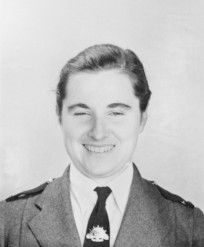
| Rank | Lieutenant |
| Service Number | NFX70991 |
| Unit | 2/10th Australian General Hospital |
| Cause of Death | Executed by Japanese in the Bangka Island massacre |
| Place of Death | Bangka Island, Indonesia |
| Date of Death | 16 February 1942 |
| Age | 26 |
History
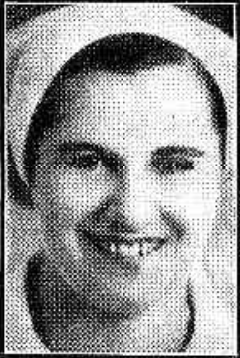
Florence Aubin Salmon was born on 20 October 1915, the daughter of Florence Alexandria Aubin and John Henry Salmon of Punchbowl, Sydney. Florence had two brothers, Leonard John Salmon (b. 1912) and Garnet Cyril Noel Salmon (b. 1919), and two sisters, Joyce (b. 1921) and Dorothy (b. after 1923).
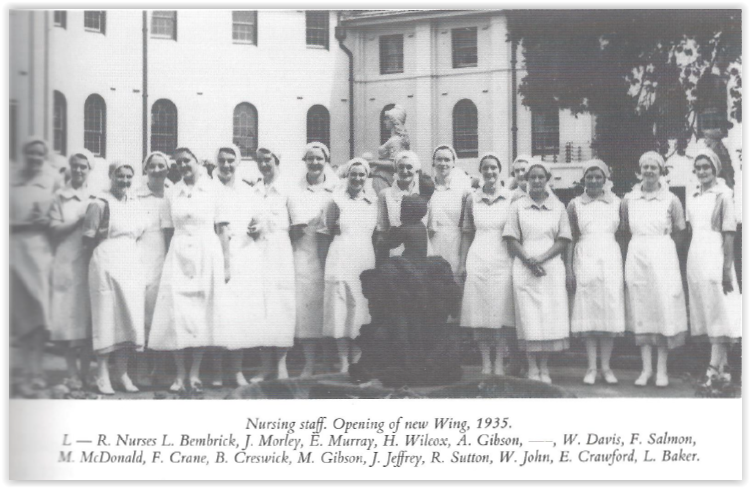
In 1934 Florence began training in general nursing at the War Memorial Hospital in Waverley, an eastern suburb of Sydney. The private hospital, owned by the Methodist Church of New South Wales, was dedicated to men and women of the eastern suburbs of Sydney who died in service during World War One. Training alongside Florence was Winifred (Winnie) May Davis. Seven years later, Florence and Winnie would serve in the same medical unit in Malaya.
In mid-1938, Florence and Winnie passed their Nurses’ Registration Board examinations and became General Nurses. In November that year they were each presented with a graduate brooch at the hospital’s annual Armistice Day Awards ceremony.
In a 1990 history of the War Memorial Hospital, Florence is remembered as a “bright and breezy lass, known to her contemporaries as ‘Sam’. She was given to calling her friends flippant and inappropriate nicknames. [She] was untiring in the care of her patients, spreading good cheer as she bustled about her duties” (Green, p. 60).
Not content to stop at general nursing, on 30 Jan 1940 Florence became a Registered Midwife after completing the requisite training at Royal North Shore Hospital.
By then, war had broken out in Europe, and by 1941 all three branches of Australia’s armed forces were engaged in North Africa, the Mediterranean, the Middle East – and increasingly southeast Asia and the southwest Pacific. More than one million Australian men and women ended up serving in World War Two.
Florence was one of them. She enlisted in the Australian Army Nursing Service (AANS) on 8 January 1941, was attached to the Emergency Unit, and posted to the army camp dressing station at Bathurst, 200 kilometres west of Sydney. On 20 February 1941 this appointment was terminated upon her transfer to the AANS’s Home Service the next day. She continued her posting at Bathurst.
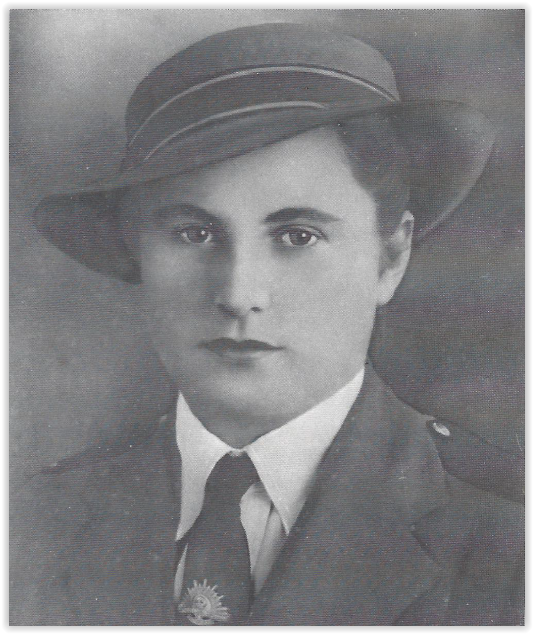
Florence’s younger brother, Garnet, had already served for a period in 1940, and upon reenlistment in 1941 served in the Middle East. Florence’s elder brother, Leonard, enlisted on 24 March 1941. He was killed on 14 May 1943 when the Centaur sank off the Queensland coast near Brisbane after being torpedoed by a Japanese submarine. The siblings’ uncle Walter J. Salmon was a petty officer serving on HMAS Perth and was killed when the ship was sunk on 1 March 1942 by the Japanese fleet in the Battle of the Sunda Strait.
By 1941 Australian authorities had recognised the threat that Japan posed, and therefore the prime importance of an arc of territory, stretching eastwards from the Malay peninsula, through the Netherlands East Indies (Indonesia) and into the southwest Pacific, in the defence of Australia. In view of this, and following discussions with British authorities, the Australian War Cabinet decided to send Australian personnel to certain strategic points in the region, among which the most important was considered British Malaya. Accordingly, in January 1941, part of the recently raised 8th Division of the Second Australian Imperial Force (2nd AIF) was assigned to the British colonial possession, initially on garrison and other non-combat duty (Walker, p. 492). The force included three medical units to which AANS nurses were attached – initially the 2/10th Australian General Hospital (AGH) and the 2/4th Casualty Clearing Station (CCS), and later the 2/13th AGH.
When Florence transferred once again – this time to the 2nd AIF – on 9 May 1941, she was attached to the first of these units, the 2/10th AGH, which had been established in Malacca in February. Florence remained at the Bathurst camp dressing station while she waited to ship out.
After taking pre-embarkation leave, Florence sailed from Sydney on 29 July on the Dutch liner turned troopship Johan Van Oldenbarnevelt, travelling as part of Convoy US11B. On board were two other nurses of the 2/10th AGH, one of whom was fellow Sydneysider Lavinia Jean Russell.
Another Dutch liner, Marnix Van St. Aldegonde, which had also been converted to a troopship, sailed from Melbourne on 30 July and met up with Johan Van Oldenbarnevelt and the other ships of the convoy in Bass Strait. Over 2,000 personnel from the 2nd AIF’s 8th Division were aboard the Marnix, including fellow 2/10th AGH members Clarice Halligan and Ada Syer.
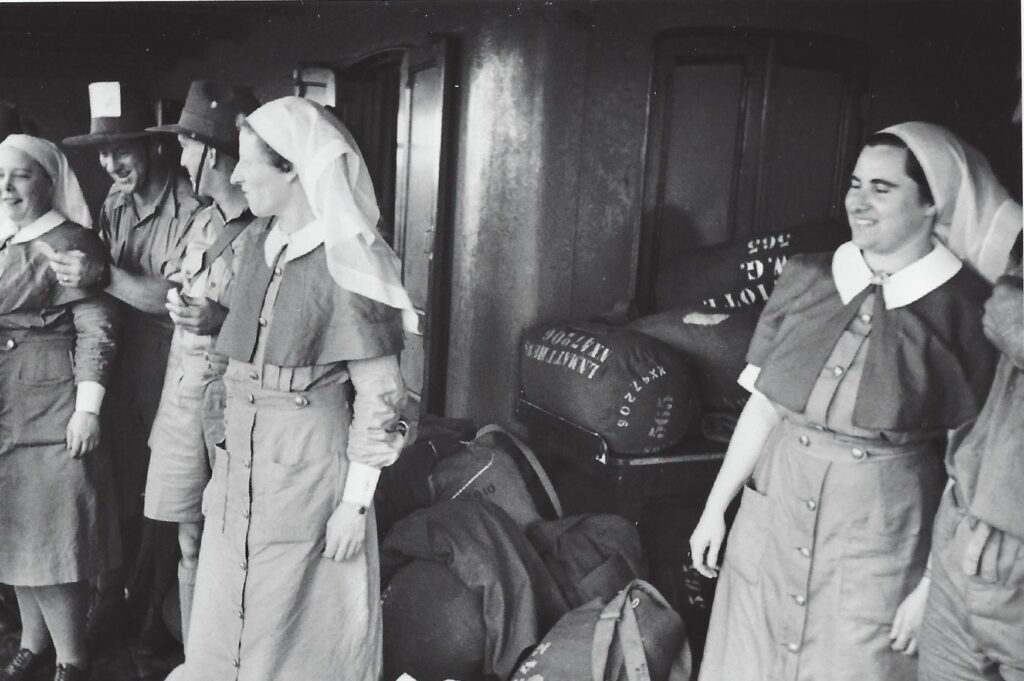
On the morning of 15 August, the ships arrived at Keppel Harbour in Singapore and the Johan Van Oldenbarnevelt berthed at Wharf No. 10. Florence, together with Lavinia, Clarice and Ada, disembarked and on 17 August took a train to Malacca – “a pleasant little town on the west coast of Malaya,” according to Pat Gunther, who had been with the 2/10th AGH from the beginning. Here the unit had been established in a section of the Colonial Service Hospital, a “large, light and airy complex containing several blocks for surgical and medical procedures, general hospital wards and staff accommodation” (Shaw, p. 28). The unit occupied 200 beds of the hospital but had the capacity to expand to 1,600 if necessary (Crouch, p. 15). The nurses’ quarters in the accommodation block were comfortable, with amenities such as sewing machines, and came complete with the services of amahs – house servants (Shaw, p. 31).
With several thousand Australian troops to care for, Florence and the other 2/10th AGH nurses were kept busy treating an average of 400 patients a month, often those with climate-induced infections, such as ‘Singapore Ear’ and tinea; broken bones and lacerations from training and other accidents; routine operations such as tonsillectomies; and occasionally diseases (Arthurson, p. 3; Shaw, pp. 29–30).
Despite this, there was plenty of time for relaxation, leisure and society. Florence and the others had occasion to attend sampan parties, chicken suppers, and tennis parties. There were dances and dinners, and parties at pools and mansions (Shaw, p. 31). While on leave the nurses visited Singapore, Kuala Lumpur and Fraser’s Hill, a colonial cool-climate hill station. Florence took at least two periods of leave between August and December.
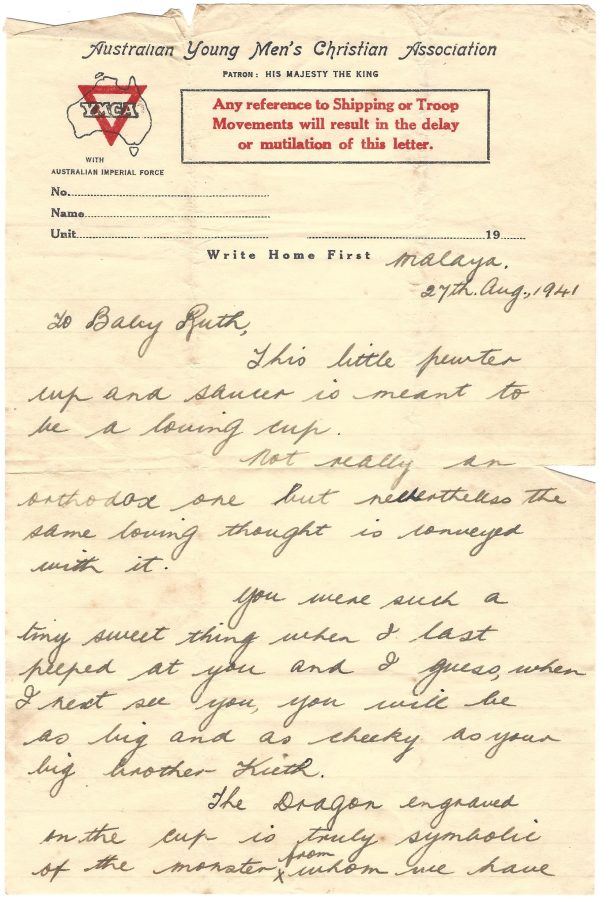
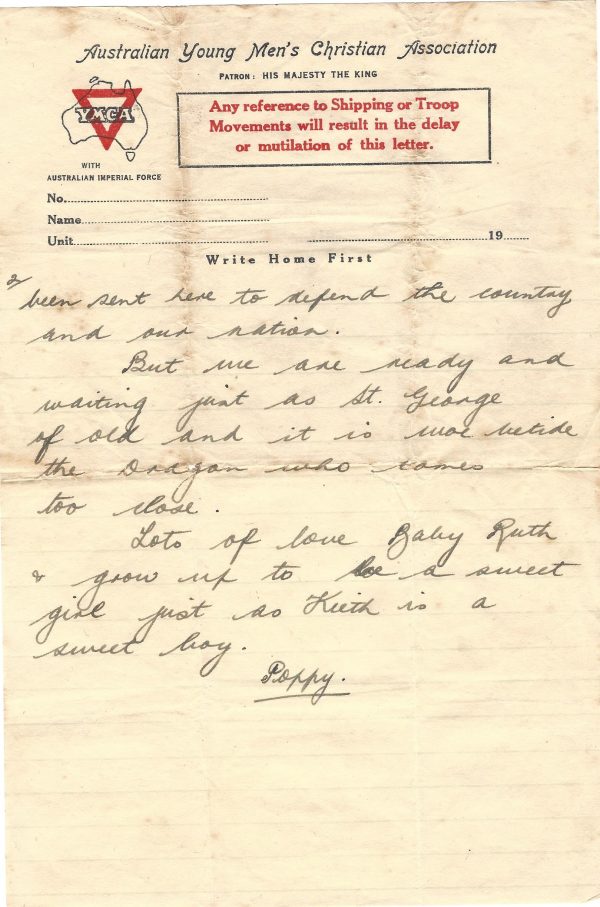
Nonetheless, when Florence wrote a beautiful letter home to her niece on 27 August 1941, she foreshadowed the danger that lay just over the horizon.
To Baby Ruth
This little pewter cup and saucer is meant to be a loving cup.
Not really an orthodox one but nevertheless the same loving thought is conveyed with it.
You were such a tiny sweet thing when I last peeped at you and I guess, when I next see you, you will be as big and as cheeky as your big brother Keith.
The Dragon engraved on the cup is truly symbolic of the monster from whom we have been sent here to defend the country and our nation.
But we are ready and waiting just as St. George of old and it is woe betide the Dragon who comes too close.
Lots of love Baby Ruth & grow up to be a sweet girl just as Keith is a sweet boy.
Poppy.
When the Imperial Japanese Army invaded Malaya on 8 December 1941, the nurses of the AANS were indeed ready and waiting. Even so, as Japanese forces pressed rapidly southwards, life for Florence and the others changed dramatically.
On 1 January 1942, when Japanese forces landed on the west coast, the position of the 2/10th AGH in Malacca became untenable. It was now virtually in the front line. By 10 January all patients had been relocated to the 2/13th AGH and staff detached to either the 2/4th CCS or the 2/13th AGH – including Florence, who was detached on 6 January to the 2/4th CCS, at that time based at the Mengkibol rubber plantation near Kluang, about halfway between Malacca and Singapore (Walker, p. 501).
On 14 January, while Florence was with the 2/4th CCS, Australian troops engaged for the first time in direct combat, near Gemas, northeast of Malacca. The following day a deadlier engagement took place, and many Australian casualties were taken along 150 kilometres of narrow winding roads to the 2/4th CCS. For the first time in Malaya an Australian medical unit received convoys of surgical cases (Walker, pp. 504–05).
When Florence rejoined the 2/10th AGH on 17 January it had completed its relocation to Oldham Hall on Singapore Island. Conditions for nursing were becoming increasingly difficult as casualties began to arrive at such a rate that nearby houses had to be commandeered to accommodate the overflow (Walker et al, p. 442).
With Japanese forces continuing their relentless march south, on 20 January, and again on 30 January, Colonel Alfred P. Derham, Assistant Director of Medical Forces in Malaya, recommended to Major General Gordon Bennett, General Officer Commanding 8th Division, that AANS nurses be evacuated from Malaya. General Bennett refused on both occasions, citing the effect of such a move on civilian morale (Walker et al, p. 443).
On the night of 8 February, the Japanese army landed on Singapore Island. The 2/10th AGH nurses were now working under near-impossible conditions. There were continual air raids, and occasionally shells fell in and around the hospital area. All travel on roads was hazardous, owing to shelling, dive-bombing and machine-gunning. The water supply was threatened, and at night there were blackouts. As heavy casualties poured in, operating theatres worked around the clock, and the wards became so overcrowded that men were lying on mattresses on the floor while others waited outside (Walker et al, p. 443).
Finally, on 9 February, General Bennett approved the nurses’ evacuation, but unsurprisingly, given their ethos of selfless service, they didn’t want to leave. Arthurson (p. 98) tells us, in respect of the nurses of the 2/13th AGH – and their 2/10th colleagues will be no different – that “many nurses wept openly as they went about their work during the 9th, 10th and 11th of February, 1942. The girls worked tirelessly among their patients arriving in the wards after a long wait for a vacant operating table. They understood the pain and suffering being endured by these heroic Australian and British fighting men. Farewells were exchanged and some messages for home were stored away among the sisters’ personal gear. The parting was the saddest day in the history of the 13th Australian General Hospital.”
Evacuations began on 10 February, when six members of the AANS embarked on the hospital ship Wah Sui with wounded Allied soldiers, and on 11 February, 60 or more AANS nurses from the 2/10th and 2/13th AGHs were embarked on the Empire Star.
On Thursday 12 February Florence and 64 other AANS nurses left Singapore aboard the SS Vyner Brooke. They were the last ones out. The small ship steamed south towards Jakarta, seeking the cover of islands, avoiding open water. On Saturday 14 February the ship was located by a Japanese aircraft, and soon dive-bombers appeared on the horizon. Captain Borton engaged evasive manoeuvres, but to no avail. Within an hour or so the ship Vyner Brooke had received three direct hits and began to sink close to Bangka Island.
Putting into effect a plan devised the previous day, the AANS nurses helped passengers to evacuate the stricken craft before endeavouring to save themselves through any means possible. Of six lifeboats deployed, only two were viable; both reached shore within the vicinity of Radji Beach on Bangka Island. A number of rafts had also slid into the water from the deck of the Vyner Brooke, as well as all manner of other floating items. The nurses and many of the passengers had also been issued with lifejackets.
One way or another Florence made it to shore on Bangka Island and ended up in the company of a large group of AANS nurses, soldiers, sailors and civilians gathered around a bonfire on the beach. The group grew in number during Saturday night and Sunday as it was joined by survivors of other ships sunk in Bangka Strait by Japanese forces, which were at that very moment invading Sumatra.
On Monday the group decided to surrender en masse to Japanese authorities, and a deputation left for the nearest large town – Muntok – to negotiate this. A short while later all the civilian women and children of the group followed behind – save one, Mrs Betteridge, a British woman whose husband lay among the injured on the beach.
Around mid-morning the deputation returned with a number of Japanese soldiers. The soldiers separated the survivors into three groups and proceeded to shoot or bayonet them in cold blood.
Florence died on Radji Beach, Bangka Island, on 16 February 1942, alongside 20 AANS colleagues. They were shot while standing in the sea. One colleague, Vivian Bullwinkel, survived.
Definitive word of the murdered nurses’ fate did not reach Australia until the liberation in September 1945 of the surviving 24 AANS nurses from Japanese internment camps on Sumatra. Thereafter the Australian public heard about what became known as the Bangka Island Massacre through print and broadcast media (Fletcher, p. 421).
Newspapers sought interviews with bereaved parents. On 23 September 1945 the Daily Telegraph published an interview with Florence’s mother, Mrs Florence Salmon, who was reported as saying that the last letter she had received from her daughter was written on 8 February 1942. “The letter was very happy,” the Telegraph writes, “and did not mention any worry about the Japanese, although it did say everyone knew they were closing in on them.” The Telegraph quotes Mrs Salmon as saying that “Sammy [as Florence was known in her family] was always a very happy girl, and lived for her nursing … The last three years of suspense, wondering what had happened to her, were dreadful, but now that I know I cannot hate anyone.”
On Sunday 28 October 1945, a memorial service was held in the grounds of the War Memorial Hospital, Waverley, in honour of Florence and her friend and colleague Winnie May Davis, who had died on 19 July 1945 as a prisoner of war in Sumatra following the sinking of the Vyner Brooke. Four hundred mourners were in attendance.
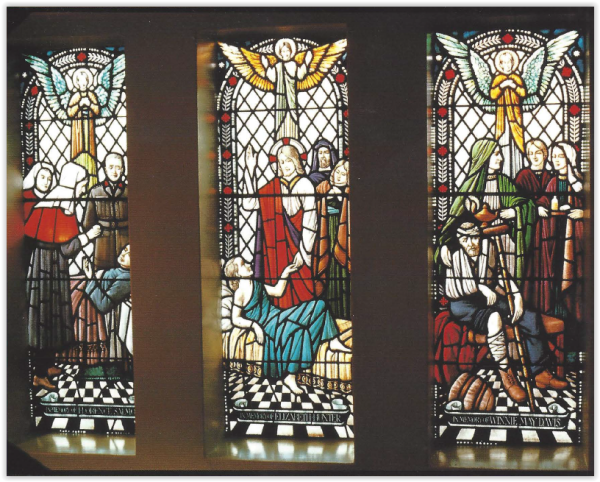
Some years later, stained-glass windows were installed in the Jeanie Morgan Wing of the hospital in memory of Florence and Winnie, who were among 18 graduates to serve in World War Two. Florence’s and Winnie’s names are also inscribed on the Roll of Honour in the Nurses’ Chapel at Westminster Abbey in London.
A small park in Punchbowl, Florence’s home suburb, is officially designated Salmon Reserve in honour of the service and sacrifice of Florence and her brother Leonard. They had grown up in Gowrie Avenue, just one street over from the park.
In memoriam Florence. Lest we forget.
Sources
2/30th Battalion A.I.F. Association, ‘Convoy US11B’.
2/30th Battalion A.I.F. Association, ‘Johan van Oldenbarnevelt (HMT FF)’.
2/30th Battalion A.I.F. Association, ‘Marnix Van St. Aldegonde (HMT EE)’.
Arthurson, L, ‘The Story of the 13th Australian General Hospital, 8th Division AIF, Malaya’, in Winstanley, P (ed., 2009), Prisoners of War of the Japanese 1942–1945.
Crouch, J (1989), ‘One Life is Ours: The Story of Ada Joyce Bridge’, Nightingale Committee, St Luke’s Hospital.
Fletcher, A (2011), ‘Sisters Behind the Wire: Reappraising Australian Military Nursing and Internment in the Pacific during World War II’, Medical History (Jul 2011, vol 55, no 3, pp. 419–424).
Goossens, R, ‘HMT Johan van Oldenbarnevelt’, SS Maritime.
Green, B (1990), ‘To Minister: The Story of War Memorial Hospital Waverley 1918–1988’, War Memorial Hospital.
Museums of History New South Wales, ‘Nurses index 1926–1954’.
Private correspondence from Florence’s great nephew.
RSL NSW, ‘The Second World War’.
Trove, Government Gazette of the State of New South Wales (29 Aug 1939, p.4281), ‘Register of Nurses as at 31st December, 1938’.
Trove, The Daily Telegraph (23 Sep 1945, p. 5), ‘Memorial for murdered nurses – Club to honour dead heroines of Singapore’.
Trove, The Methodist (9 Jul 1938, p. 9), ‘Personal and General’.
Trove, The Methodist (26 Nov 1938, p. 1), ‘Armistice Day at the War Memorial Hospital’.
Trove, The Sydney Morning Herald (24 Jun 1938, p. 6), ‘Examinations for Nurses’.
Trove, The Daily Telegraph (23 Sep 1945, p. 5), ‘Memorial for Murdered Nurses’.
Trove, The Sydney Morning Herald (29 Oct 1945, p. 5), ‘Memorial Service for Nurses’.
University of NSW, Canberra, Australians at War Film Archive, Pat Darling (née Gunther) interviewed on 2 May 2003, audio and transcript.
Walker, A S (1953), Second World War Official Histories, Australia in the War of 1939–1945. Series 5 – Medical, Volume II – Middle East and Far East, Chapter 23 – Malayan Campaign.
Walker, A S et al (1961), Second World War Official Histories, Australia in the War of 1939–1945. Series 5 – Medical, Volume IV – Medical Services of the Royal Australian Navy and Royal Australian Air Force with a section on women in the Army Medical Services, Part III – Women in the Army Medical Services, Chapter 36 – The Australian Army Nursing Service.