
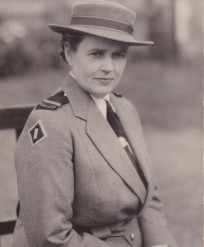
| Rank | Lieutenant |
| Service Number | SFX13418 |
| Unit | 2nd/13th Australian General Hospital |
| Cause of Death | Murdered by Japanese troops on Bangka Island |
| Place of Death | Bangka Island, Indonesia |
| Date of Death | 16 February 1942 |
| Age | 38 |
History
Sister Florence ‘Flo’ Rebecca Casson, SFX 13418, was the daughter of Henry and Mary Casson of Willaston, South Australia. She was born in Warracknabeal, Victoria on 6 March 1903. Flo trained as a nurse, and the first record of her nursing career is at the Royal Adelaide Hospital in 1935 in a group photo titled ‘Matron Draw with Night Nurses’.
Soon after she must have moved up in her career, as she became the Matron at a number of small country hospitals, including those at Jamestown and Port Pirie, and the Soldiers’ Memorial Hospital in Pinaroo, a small South Australian country town near the South Australian–Victorian border.
On 7 February 1941 Flo Casson enlisted at Keswick, South Australia with the Australian Army Nursing Service and travelled to Malaya with the 2/13th Australian General Hospital.
After service in Malaya and Singapore she boarded the SS Vyner Brooke, and at the time of the bombing attack on the ship she was located in the saloon with other nurses where she was hit with a bomb blast, along with Rosetta Wright and Clare Halligan (On Radji Beach, p.153). The blast caused severe damage to her legs, one of which was possibly fractured, and she had to be assisted up to the main deck. Somehow her friends managed to get her into the second lifeboat that was launched with severely wounded nurses on board.
This lifeboat drifted ashore at Radji Beach later that night. Sister Vivian Bullwinkel and Sub-Lt Jimmy Miller, Royal Naval Reserve (Engineer Officer on the Vyner Brooke) walked along the beach to where a large bonfire had already been lit by survivors in order to obtain assistance with carrying the wounded nurses to the main camp.
Flo Casson and Rosetta Wright were the most seriously wounded. As described in Ian W. Shaw’s On Radji Beach (p. 200), “They were both strong and brave women, but their wounds were severe. Again, shell splinters had caused the damage, with both women suffering deep wounds to the buttocks and upper thighs. They were unable to walk, and had to be fed and helped with their toilet functions. The wounds appeared to have caused nerve damage, perhaps fractures, and they needed more specialised treatment than any that could be provided on the beach. […] Miller eventually put together a rescue party and set off. The journey to the second lifeboat and back with its survivors took over two hours, and the wounded nurses were in agony on the return journey, having to be half-dragged, half carried for most of the distance. Their pain was obvious and it, in turn, increased the distress of the other survivors.”
When dawn broke on Sunday 15 February 1942, Flo was probably lying on a makeshift stretcher in the shade of the jungle on Radji Beach with the other wounded. They were being cared for by Matron Drummond and her nurses and a Chinese doctor who had also survived the sinking (possibly a Dr Chan), plus a group of survivors numbering about 70.
It seems that Flo and a few other more seriously wounded were later that day transferred to a fisherman’s uninhabited hut further down the beach towards the headland. Flo spent another night on the beach being cared for by her companions with what little they had in the way of medical supplies.
At dawn on Monday 16 February the survivors were joined by another lifeboat and rafts with many wounded people from ships that sank in the Bangka Strait during the night. The sheer volume of wounded seems to have tipped those in authority to sending the women and children and a few walking-wounded men on a trek towards the nearest town. The nurses were also invited to join that group but declined.
The nurses knew that it was their duty to stay with and look after the wounded, regardless of their difficulties.
So Flo was amongst the group of nurses destined to be executed by the Japanese. Once the Japanese had executed firstly the officers and then the second group of other ranks and civilian men they turned their attention to the nurses. Forming the nurses into a line facing the sea, with Flo and her wounded friends being supported at the righthand end of the line by other sisters (On Radji Beach, p. 216), the Japanese carried out one of their most abhorrent war crimes against Allied women on record.
On Radji Beach (p. 217) states that “Flo and Rosetta and Clare and the sisters supporting them fell under the gun, grouped together in death as in life.”
So life was taken from Flo at the age of 39 years after several decades of unselfishly caring for others in need.
Flo Casson is memorialised by a plaque at Pinaroo Soldiers Memorial Hospital, where the Health Promotion Room is also named after her. There is also a plaque at the Royal Adelaide Hospital and at Moonta cemetery in South Australia. At the grave of her parents, Flo is remembered by a plaque inscribed with her name and that of her brother, himself a former POW.