
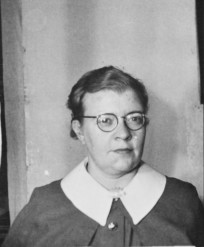
| Rank | Matron |
| Service Number | SFX10594 |
| Unit | 2nd/13th Australian General Hospital |
| Cause of Death | Murdered by Japanese troops at Bangka Island |
| Place of Death | Bangka Island, Indonesia |
| Date of Death | 16 February 1942 |
| Age | 36 |
History
Matron Irene Drummond SFX10594 was the senior Australian on the beach on that fateful day and her extraordinary courage will always be remembered.
”Chin up, girls. I’m proud of you all and I love you all.” So Matron Drummond called out as she walked into the water to her death on Radji Beach.
Irene Melville Drummond was born on 26 July 1905 at Ashfield, Sydney, daughter of Cedric Drummond, marine engineer, and his wife Katherine, née Melville, both Queensland born. Educated at Catholic schools in Adelaide and in Broken Hill, New South Wales, Irene returned to Adelaide, trained as a nurse at Miss Laurence’s Private Hospital, qualified in obstetrics at the Queen’s Home and worked at Angaston Hospital.
In 1933 she moved to the Broken Hill and District Hospital where she proved to be a compassionate and extremely competent nurse, well liked and respected by her superiors and colleagues. She served as a surgical sister, assistant matron and acting matron. In Ian W. Shaw’s book On Radji Beach (p. 14), Irene is described as being “like a mother hen fussing over her chicks and greeting all with a cheery smile and a friendly squeeze of the shoulder.”
Irene Drummond joined the Australian Army Nursing Service at Keswick, South Australian on 23 July 1940, although her Oath of Enlistment in the Australian Imperial Force is dated 8 November 1940. She was called up for full-time duty with the 2/4th Casualty Clearing Station in January 1941. Next month she sailed for Singapore to join the 2/9th Field Ambulance. Briefly back with the 2/4th CCS, she was promoted to Matron on 5 August and posted to the 2/13th Australian General Hospital in September.
When the Japanese invaded Malaya on 8 December, the hospital was situated near Johor Bahru. In January 1942 it was hurriedly moved to St Patrick’s School, Singapore. Despite chaotic conditions brought on by the hasty retreat, enemy air raids and increasing admissions of battle casualties, Drummond’s quiet efficiency helped to ensure that the wards were operational within 48 hours.
By early February 1942 surrender to the Japanese appeared likely. Throughout January, Major General Gordon Bennett had repeatedly refused to allow the evacuation of AANS personnel. It was not until 10 February that they began leaving, five days before the capitulation. By 12 February only Drummond, Matron Olive Paschke of the 2/10 AGH, and 63 members of their staffs remained in Singapore. Although the nurses had begged to be allowed to stay with their patients, they were put on board the small ship SS Vyner Brooke for the perilous voyage to Australia.
It is now well known history that on 14 February in Bangka Strait off Sumatra the ship was hit by bombs. The nurses helped other passengers to abandon ship. Scooping up a small Chinese boy as the Vyner Brooke sank, Drummond escaped in a lifeboat.
A group of survivors, including Drummond and 21 fellow nurses, came ashore at Radji Beach, Bangka Island. They were joined by civilians and servicemen from other sunken ships. Having discovered that the island was already in the hands of the Japanese and that no help could be expected from the local population, on 16 February the party resolved to surrender. One of the Vyner Brooke’s officers was sent to nearby Muntok to negotiate with the Japanese.
While he was away Drummond suggested that the civilian women and children should leave for Muntok. Her suggestion undoubtedly saved many lives. Shortly after the civilians departed, a Japanese officer and about 20 soldiers arrived at the beach.
Ignoring pleas that the remaining group was surrendering, the Japanese separated the men from the women. The men were marched in two groups around a small rocky headland to another area where they were shot and bayoneted. The Japanese returned to the nurses who had been left sitting on the beach and ordered them to walk into the sea.
All knew their fate as they entered the water in silence. The Japanese soldiers opened fire with a machine-gun. Irene Drummond was one of the first to die.
Matron Drummond was posthumously promoted to the rank of Major on 23 March 1943 and later to Lieutenant Colonel and was mentioned in dispatches in 1946. The citation read “The King has been graciously pleased to approve that the following be Mentioned in recognition of gallant and distinguished services in Malaya in 1942” (Supplement to the London Gazette, no. 37671, p. 3919, 1 August 1946).
At the Australian War Memorial in Canberra are two original letters written by Matron Drummond to her sister in Australia. The letters are handwritten and dated 17 December 1941 and 5 February 1942. They describe the war conditions in Malaya following the outbreak of war with the Japanese.