
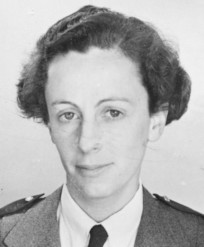
| Rank | Staff Nurse/Lieutenant |
| Service Number | NFX76285, NX76285 (N108167) |
| Unit | 2/13th Australian General Hospital |
| Cause of Death | Executed by Japanese in the Bangka Island massacre |
| Place of Death | Bangka Island, Indonesia |
| Date of Death | 16 February 1942 |
| Age | 29 |
History
Nancy (also known as Nance) Harris was born on 15 January 1913 in Guyra, NSW, the daughter of Florence Cecily Cumming and Dr John Solomon Harris. She had an elder sister, Hannah (known as Jean, her middle name), who was born in 1910.
As a child, Nancy was a pupil of the Ursuline Convent in Guyra. When she was a little older, Dr Harris sold his practice in Guyra and the family moved to North Sydney. They received a warm farewell before they left.
In Sydney, Nancy attended Presbyterian Ladies’ College in Pymble. Upon finishing school, she decided to take up nursing and trained at Royal North Shore Hospital. She passed her nurses’ final examination in May 1935 and became registered in general nursing on 14 November of the same year.
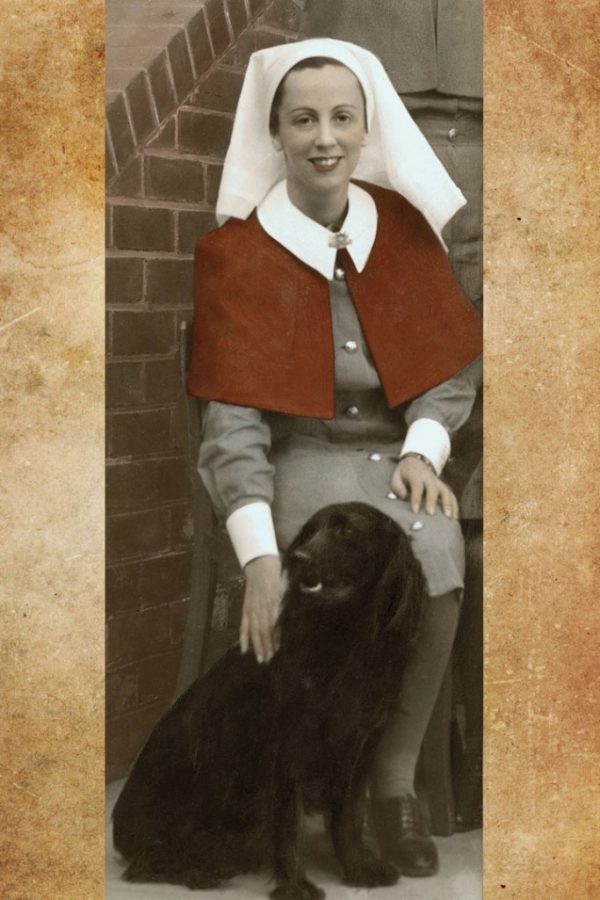
In 1941 Nancy enlisted in the Australian Army Nursing Service (AANS) and was called up for duty on 19 August. She was attached to the 2/13th Australian General Hospital (AGH) as a Staff Nurse and 10 days later embarked for Malaya aboard the Wanganella.
The Wanganella arrived in Singapore on 15 September. However, instead of travelling with her unit to its temporary base at St. Patrick’s Boys’ School in Katong, on the south coast of Singapore Island, Nancy and nine other 2/13th AGH nursing colleagues were detached to the 2/10th AGH in Malacca. The 2/10th AGH had travelled to Malaya in February aboard the Queen Mary, along with the third Australian unit with AANS staff attached, the 2/4th Casualty Clearing Station (CCS).
In Malacca, Nancy learned tropical nursing from her more experienced colleagues, and when she returned to St. Patrick’s on 6 October, she was able to pass on her new knowledge to other 2/13th staff. In the meantime, another rotation of 2/13th nurses travelled to Malacca.
During their time at St. Patrick’s, Nancy and the other nurses enjoyed the attention of wealthy British expats resident in Singapore and were often invited to dinners, dances and excursions. One evening, Nancy and her colleague Vivian Bullwinkel were invited by Peg and Richard Hanson to dinner on a ship in Keppel Harbour. They were taken out to a luxury yacht owned by the so-called White Rajah of Sarawak. It was named the Vyner Brooke.
Nancy was detached again to the 2/10th AGH on 30 October, and by the time she rejoined her unit on 13 December, the 2/13th AGH had moved across Johor Strait to a site in Tampoi, and the Imperial Japanese Army had invaded Malaya.
Faced with minimal resistance from overwhelmed British and Indian troops, the Japanese invasion force moved swiftly southwards. The entry of Australian soldiers into active combat in mid-January did little to stop them, and by the end of January they had reached the northern side of Johor Strait. Across the water lay Singapore Island.
By 25 January the two Australian General Hospitals had been evacuated to Singapore. The 2/13th AGH returned to St. Patrick’s and the 2/10th had moved into Oldham Hall. The 2/4th CCS was not far behind.
Despite strong opposition from Australian troops, on 8 February Japanese forces crossed Johor Strait and established a bridgehead on the island. Singapore was doomed.
By now, St. Patrick’s was so overcrowded with wounded combatants that outbuildings and even tents were used as wards. Casualties lay closely packed on mattresses on floors or even outside on the lawns. From outside the school came the constant noise of artillery fire. Nancy and her colleagues worked under enormous strain but were magnificent.
On 9 February, in response to Japanese atrocities in Hong Kong, Major General Gordon Bennett ordered the evacuation of the 130 AANS nurses now in Singapore. Unsurprisingly, the nurses did not want to leave hundreds of wounded patients in the lurch and refused to volunteer. In the end, Nance and the others had to be ordered to leave by the senior matron in Malaya, Olive Paschke of the 2/10th AGH. Many nurses wept as they went about their work on these final days in Singapore. On 10 February, with Japanese forces closing in, six nurses left aboard the Wah Sui. The following day 59 more departed on the Empire Star. Then, on Thursday 12 February, the final 65 nurses, among whom was Nance, were evacuated aboard Vyner Brooke.
In the gathering dusk the Vyner Brooke steamed slowly out of Keppel Harbour. As the ship departed, several of the nurses looked back at the waterfront to see a city ablaze. For the next 36 hours, the ship made its way slowly and without incident through the many islands that line the passage between Singapore and Jakarta, its destination.
Then, in the early afternoon of Saturday 14 February, the Vyner Brooke was bombed by Japanese aircraft as it was entering Bangka Strait. In a short period of time, some 27 bombs were released. Most missed but eventually one entered through the ship’s funnel and exploded in the engine room. The ship lifted and rocked with a vast roar. Then another struck the ship, and another, and the Vyner Brooke was doomed. It began to sink and within 30 minutes was beneath the waves.
After treating the wounded as best they could, and helping women, children, the elderly and the wounded into the available lifeboats, Nancy and her colleagues abandoned ship wearing the life jackets they had been issued with. Some found their way onto lifeboats – or just as likely trailed behind – while others clung to rafts and debris. Those who could swim made for nearby Bangka Island.
Nancy made it to shore late on Saturday night in the vicinity of Radji Beach, where she joined a large group of AANS nurses and civilians around a bonfire. Later, more survivors of ships bombed by Japanese forces came ashore and joined the group. Among them were many wounded.
Sunday passed by, and on Monday it was decided that the group should surrender en masse to Japanese authorities. A deputation left for the nearest large town, Muntok, to negotiate this. A short while later most of the civilian women and children of the group followed behind.
The Australian nurses were duty-bound to remain with the wounded on the beach.
Around mid-morning the deputation returned with Japanese soldiers. The soldiers separated the survivors into groups. They took the men around a bluff in two groups and proceeded to shoot and bayonet them.
They returned to the nurses and the remaining civilians. They ordered the nurses and one, perhaps two, civilian women to advance into the water and form a line, facing the sea. They shot them as they stood there, looking out to sea, knowing their fate.
Nancy and 20 colleagues died on Radji Beach, Bangka Island, on 16 February 1942. One colleague, Vivian Bullwinkel of the 2/13th AGH, miraculously survived.
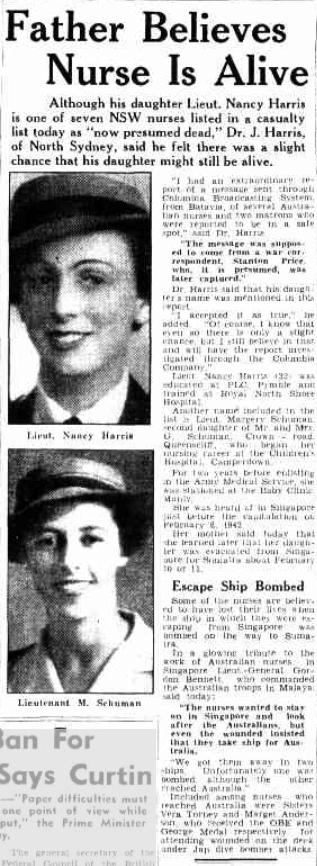
On 12 January 1945, nearly three years after Nancy’s death, the Australian Army’s NSW Echelon and Records section issued a notice to her mother and father. “I regret to inform you,” the notice states, “that following intensive examination of the evidence in hand regarding the fate of certain members of the A.A.N.S. who were serving in Malaya, and the absence of any communication from them, the decision has been reached that it must be presumed they lost their lives during or as a result of the aerial attack on the transport on which they were travelling near Sumatra. The personal documents of your daughter … have therefore been endorsed as follows: ‘Previously reported missing believed killed on or after 11 February now reported became missing on 14 February 1942 and is for official purposes presumed to be dead’. With the deepest sympathy of the Minister for the Army and Commander in Chief.”
Despite this, the 24 January 1945 edition of the Sydney Morning Herald reports that her parents had refused to give up hope that their daughter might be still alive. “Of the 66 nurses who were on the ship that was bombed, it is known that 33 were killed and 33 were saved,” Florence Harris is quoted as saying. “Relatives of some of the girls who were saved had letters saying that they were living in a Dutch bungalow in Kalambang [sic] and were being treated as civilian internees. We feel that until those girls are repatriated we will never know what really happened.”
In September that year Florence and John Harris finally learned the truth of their daughter’s tragic fate. When the 24 surviving nurses were freed from captivity deep in the jungle of Sumatra and flew to Singapore, they brought with them news of those who had died on Radji Beach, of those who had drowned when the Vyner Brooke was bombed, and of those who had perished in the internment camps. In time, the national outrage and mourning that followed gave way to memorialisation and commemoration, which continues to this very day.
Nancy’s name is honoured in Australia, Singapore and England. It is recorded on panel 96 in the Commemorative Area of the Australian War Memorial in Canberra. It is recorded on the Singapore Memorial at Kranji War Cemetery in Singapore. And it is recorded in the roll of honour in the Nurses’ Memorial Chapel in Westminster Abbey in London.
Lest we forget.