
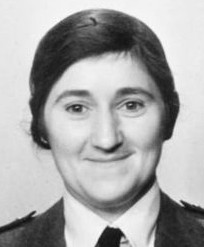
| Rank | Staff Nurse |
| Service Number | VX61329 |
| Unit | 2/13th Australian General Hospital |
| Cause of Death | Executed by Japanese in the Bangka Island massacre |
| Place of Death | Bangka Island, Indonesia |
| Date of Death | 16 February 1942 |
| Age | 33 |
History
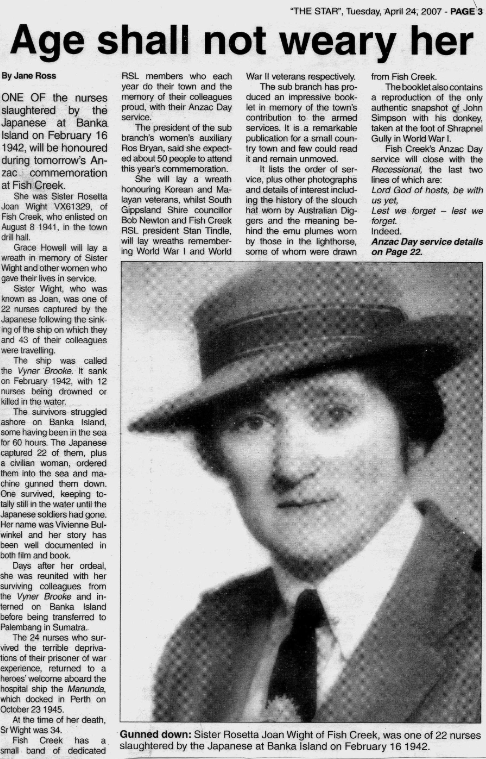
Rosetta Joan Wight (known as Joan) was born on 3 Dec 1908 in Fish Creek, a small town near the coast in South Gippsland, Victoria. She was the daughter of Rosetta Frances Brown (1884–1964) and Leslie Rivers Wight (1869–1959), who had moved to Fish Creek only 10 months or so before Joan was born. Previously the family had lived in Melbourne, where Joan’s brother, Leslie (1906–1999), was born. Her sisters, Violet (1910–1999) and Dorothy (1913–1986), were both born in Foster, near Fish Creek.
Joan’s father Leslie was born in Kensington, London, and moved with his family to Australia as a child. His father died in Melbourne when Leslie was 14. In 1905 he married Rosetta Frances Brown.
In Fish Creek the family lived on a farm called ‘Carlisle’. The Wight children attended Doomburrim State School, no. 3428.
Leslie Wight must have been doing well, for in 1929 it was reported in Melbourne’s Table Talk newspaper that “Mr. Leslie Wight, of Fish Creek, runs a Durant tourer,” a moderately expensive car.
In 1931 Joan was living at ‘Statenboro’, a private nursing home at 2 Robertson St, Toorak, and working as a nurse. At some point she undertook nurses’ training at Bendigo Hospital and in March 1935 passed her Nurses’ Board Examination. Joan appears never to have become registered.
By 1937 Joan had returned to South Gippsland and was living and nursing at ‘Carinya’, a private nursing home in Meeniyan.
When war broke out in Europe, Joan volunteered, and on 14 January 1941 enlisted in the Australian Army Nursing Service (AANS) as a Staff Nurse. She was not the first in her family to serve. Her maternal uncle William Brown joined the Australian Imperial Force in 1916, shipped off to France and was killed in Belgium in 1917. In April 1942, Joan’s brother, Leslie, followed his sister’s lead and enlisted too.
Two weeks after Joan’s enlistment, on 30 January, she was posted to the hospital at Dandenong Camp (also known as Rosehill Camp) in Melbourne’s outer east. On 10 March Joan was transferred to the 107th Australian General Hospital (AGH) at Puckapunyal, in country Victoria.
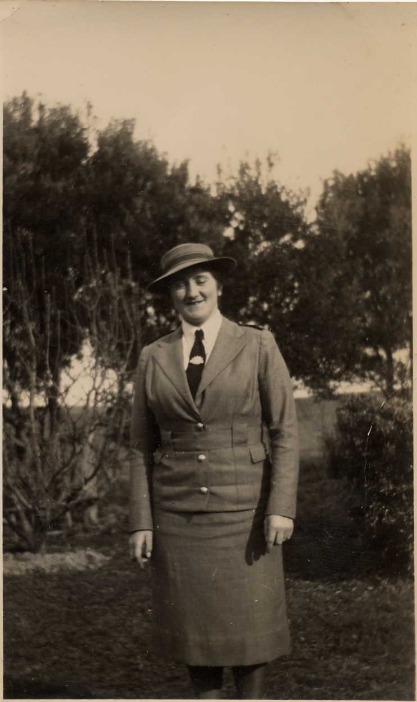
Joan was called up for overseas service with the Second Australian Imperial Force (2nd AIF) on 8 August. She remained at Puckapunyal until 12 August, at which time she was granted five days’ pre-embarkation leave. Joan’s home service appointment was terminated on 31 August and the following day she was attached to the 2/13th Australian General Hospital (AGH) for deployment to Malaya as part of the 8th Division.
On 2 September, at Station Pier, Port Melbourne, Joan boarded the ship that would carry her to Singapore, HMAHS Wanganella. The ship was looking immaculate. It was painted all in white with large Red Crosses on its hull (Arthurson, p. 6).
The Wanganella had begun life as the MS Achimota in 1929. In 1932 it was sold to Melbourne-based coastal-shipping company Huddart Parker Ltd and renamed TSMV Wanganella. With the outbreak of the Second World War, the Wanganella was commissioned in July 1941 by the Australian Government to serve as a hospital ship. It officially became HMAHS Wanganella and served in this capacity from May 1941 to 1946.
Embarking with Joan in Melbourne were 22 Victorian, South Australian and Tasmanian 2/13th AGH colleagues. Already aboard were 19 others from New South Wales and Queensland. They had embarked in Sydney four days earlier, on 29 August.
At 5.00 pm on 2 September, the Wanganella, with 42 AANS nurses and around 170 other 2/13th AGH staff aboard, pulled away from Station Pier and headed out through the Port Phillip Heads into Bass Strait. On 8 February the ship reached Fremantle. Here the unit’s staff were granted 14 hours’ shore leave. When they sailed again the following day, seven more nurses had joined the others. They were now 49 (Arthurson, pp. 6–7).
When the Wanganella arrived at Victoria Dock on Singapore Island on 15 September, the AANS nurses were met by Col. Wilfrid Kent-Hughes, Assistant Adjutant and Quartermaster General of the 2nd AIF 8th Division. Col. Kent-Hughes, who was an Australian politician when not a soldier, had organised buses to transport Joan and 38 colleagues the 11 kilometres to their billets in St. Patrick’s School, on the East Coast Road in Katong in the island’s southeast (Arthurson, p. 95).
The remaining 10 nurses were detached to the 2/10th AGH and entrained for Malacca, on the west coast of the Malay peninsula around 200 kilometres northwest of Singapore Island, where the unit was based. Over the next two months the nurses of the 2/13th AGH would be detached here on a rotating basis both to relieve their 2/10th AGH colleagues, who had been in Malaya since February and learn tropical nursing from them. Then when the 2/13th AGH nurses returned to St. Patrick’s they in turn instructed the nursing orderlies and stretcher bearers (Arthurson, p. 95).
Late in the day, Joan and her colleagues travelled in sweltering heat to St. Patrick’s School. The unit would be based here until a section of a psychiatric hospital in Tampoi, near Johore Bahru in the southern Malay peninsula, could be got ready for it. Currently the site was occupied by the 2/4th Casualty Clearing Station (CCS), which had arrived in Malaya with the 2/10th AGH and was the third of the AANS-staffed medical units in Malaya (Arthurson, p. 9).
A.C. (Lex) Arthurson, an Orderly Corporal in the 2/13th AGH, provides an insight into what Joan encountered when she and the others first arrived at Katong. “St. Patrick’s School occupies 15 acres on the island’s southern coastline. The place looked smart and clean. It consisted of 3 large buildings with many outhouses. Two main buildings were three-storied, built of brick, and containing modern conveniences. Officers, nurses, Sergeants and O.Rs [Other Ranks] were allocated their areas of living, sleeping and eating. Blackout conditions were to be in force for 2 nights. Sleep was difficult the first night under a mosquito net on a charpoy in very humid heat. Perspiration just poured out from us and frequent showering was necessary. In the morning, some compensation was the beauty of the grounds – the beautiful hibiscus, the many coloured bouvardia and the heady frangipani. Drains everywhere are 3 to 4 feet deep and care must be taken when moving about during blackouts. There were some with abrasions on their legs after the first night as they misjudged” (Arthurson, p. 9).
According to Arthurson (p. 95), Joan and her fellow nurses “were entertained like royalty” due to the “scarcity of unmarried ladies among the island’s population of 9,000 Europeans, and also because of their charm.” There were sightseeing tours of Singapore, “truly a beautiful tropical jewel.” There were invitations to tennis at the many lovely private homes. The entertainment at the houses of Dr. John and Mr. Howl, the Attorney-General, was reportedly memorable. “The beauty of their green grass courts surrounded by albrizzia trees, bougainvillea, hibiscus, orchids and frangipani was really something,” Arthurson notes. Then there were dinners and dances at the Airport Hotel “with its extensive menus.” But the most popular spot in Singapore for the nurses was the renowned Swimming Club, where each nurse was made an honorary member.
However, it was not all recreation for Joan and her colleagues. Arthurson (p. 95) writes that visits were arranged to the Alexandra Military Hospital “to view the malarial films [i.e., microscope slides] and, then, at Tan Tock Sang hospital, on Friday afternoons, there were clinics conducted by Professor Ransom and Dr. Wallace. Others visited Singapore General Hospital and were acquainted with beri-beri and typhoid patients, mostly Chinese.”
On 19 September Matron Irene Melville Drummond joined the unit from the 2/4th CCS. “Wearing spectacles and most often a smile,” Lex Arthurson writes, “Matron Drummond very soon won the respect and good-will of the newly arrived nursing staff” (Arthurson, p. 95).
On 10 October, another 24 nurses were detached to the 2/10th AGH for training. Then on 29 October 10 more travelled to Malacca, including Joan (Arthurson, p. 12–3).
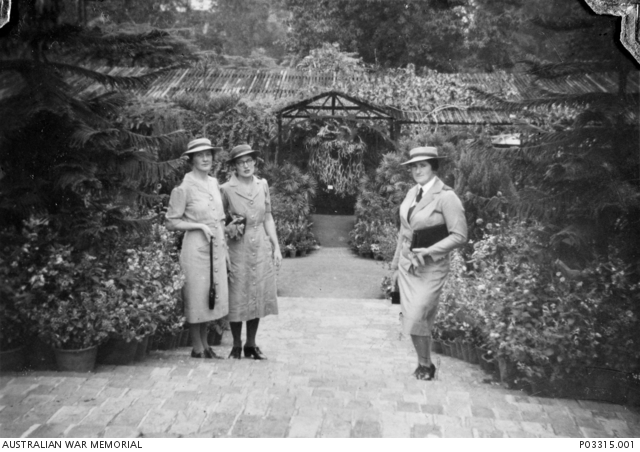
Joan spent around six weeks in Malacca with the 2/10th AGH. The unit was based in part of the Colonial Service Hospital, a modern complex with full facilities for all medical and surgical work set in beautifully lush, landscaped grounds. Originally equipped with 400 beds, by the time Joan arrived the unit was able to cope with up to 1,600 patients (Walker 1962, p. 495; Shaw, p. 28). The light and airy nurses’ quarters on the top storey of one of the wings received sea breezes and enjoyed an outlook over the picturesque surrounds, and the nurses’ domestic chores were taken care of by maids (Shaw, pp. 28–31). Nevertheless, according to Jessie Simons, Joan’s 2/13th AGH colleague who was detached to the 2/10th AGH on the same day as Joan, “it was, like most hospitals, vastly inconvenient to work in. We walked many unnecessary miles every day and often longed to knock out a couple of doors in odd walls” (Simons, p. 3).
As in Singapore, Joan had many opportunities for recreation. During time off she could play golf and tennis and had access to a swimming pool. There were invitations to parties and dances. There was shopping in Malacca. When on leave she could visit Kuala Lumpur (Walker 1961, p. 442). Jessie Simons noted later that during her time in Malacca she “felt more like a tourist than a member of an army unit. The picturesque old town, the ships offshore … and the feeling of history about the place all helped to make our first months in Malaya a queer interlude.” Joan may have been among those nurses who visited Kuala Lumpur with Jessie, “where we behaved like ordinary globe trotters” (Simons, p. 2).
With thousands of garrisoned Australian troops to look after, there was nevertheless plenty of work for Joan. From April to December, the 2/10th AGH received an average of 400 patients a month (Arthurson, p. 5). The nurses treated tropical maladies such as malaria, tinea, prickly heat and infected ear (also known as ‘Singapore ear’). They attended to numerous accidental injuries, including broken bones and lacerations from training, and assisted with routine operations, such as tonsillectomies.
Meanwhile, the 2/13th AGH had finally moved over the Johore Strait and into the psychiatric hospital at Tampoi. The rambling, single-story complex of concrete buildings had been leased from the Sultan of Johore and was situated around 10 kilometres from Johore Bahru, the capital of Johore state. One hundred tons of equipment had been transported from Katong to Tampoi between 21 and 23 November, and the nurses and ward staff of the unit had worked tirelessly for days to make the wards suitable for casualty patients, in the event that they were needed. This was to prove the case in only a matter of weeks. The 2/4th CCS, for their part, had transferred to a site at Kluang, 100 kilometres north of Johore Bahru (Arthurson, p. 15).
In the early hours of 8 December, five days before Joan returned to the 2/13th AGH, Japanese troops landed on the north coast of Malaya at Kota Baruh. Later, at 4.30 am, 17 Japanese planes bombed Singapore. Arthurson paints a vivid picture of the attack. “Suddenly the bubble burst when all [at Tampoi] were awakened at 0430 hours on 8/12/41 by the sound of shells being fired at aeroplanes, in formation, silvery looking in the full moon heading south towards Singapore. Search-lights crossed the sky – tracer bullets and ak-ak shells tried their hardest. Then the sound of bombs hitting earth – most likely Singapore’s strategic positions, airfields and oil installations” (Arthurson, p. 16).
On the same morning, Hawaii and the Philippines were bombed. The Pacific War had begun.
On 12 December, one day before Joan rejoined the unit at Tampoi, the 2/13th AGH received a memo a from Lieutenant Colonel John George Glyn White, Deputy Assistant Director of Medical Services of the 8th Division, ordering the hospital to expand from 600 to 1,200 beds. The memo also ordered that Red Cross brassards from then on be worn by all ranks on the left arm. By 15 December two new wards had been set up and the number of available beds had grown to 643. On the same day ten more 2/13th AGH nurses returned from detachment to the 2/10th AGH (Arthurson, p. 16).
Soon Christmas Day arrived. The cooks of the 2/13th AGH provided a splendid menu. Church services were held. Lieutenant General Henry Gordon Bennett, commanding officer of the AIF in Malaya, sent Christmas wishes. The unit even received a visit from the Sultan of Johore. Two days later a lively party was held, organised by the nurses. Half the unit’s personnel attended in the afternoon and half in the evening. Food, alcohol and cigarettes were provided, and reportedly everyone had a most enjoyable time (Arthurson, p. 17).
All the while Japanese forces were pressing relentlessly southwards and meeting little meaningful resistance from British and Indian troops. It was only with the entry into combat of Australian troops of the 2/30th Battalion on 14–15 January 1942 at Gemas that the Japanese received a check, and then only a minor one.
Following this engagement, convoys of Australian casualties were sent via the 2/4 CCS to the 2/13th AGH, which by now had 1,165 beds ready and had worked hard to prepare operating theatres to receive the anticipated casualties. Arthurson tells how, on the evening of 16 January, “the war hit us right between the eyes. Men, on stretchers with tickets pinned to them showing the most urgent injuries, were delivered in rapid succession from transports of all types … The admission room quickly established identity, rank, injury of the admitted. Stretcher bearers ran the battle casualty to either ward or theatre. Matron Drummond had her staff fine-tuned and expert attention was provided at all times.” As more and more casualties arrived, between 16 and 21 January some 200 medical and minor surgical cases were transferred to 2/10th AGH, which had by 15 January transferred to Oldham Hall on Singapore Island (Arthurson, p. 18–19).
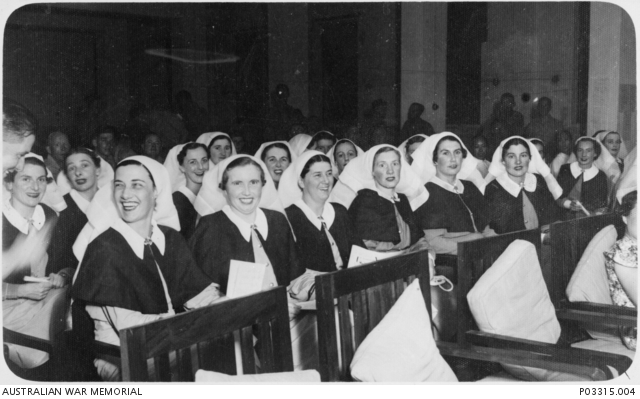
Soon the 2/13th AGH itself was compelled to relocate, and a decision was made on 21 January to return to St. Patrick’s School at Katong. The move, over the two days of 24–25 January, was a spectacular feat of logistics. It is worth quoting Arthurson at some length. “The movement of the hospital equipment was an enormous exercise,” he writes. “Indians and Malays drove the transports to Singapore and convoys of 20–30 trucks would set off. The drivers were a constant headache – couldn’t follow closely enough – didn’t know the way. The fact of the matter was that Singapore was being bombed and trucks had to be re-routed as roads disappeared in front of them … Dismantling the wards was hard work and the sound of guns and bombs could be plainly heard as the task went on. When, finally, the 13th Australian General Hospital settled back in St. Patrick’s school, all were dog-tired but the work of caring for patients had to be carried on.” Three days later, the number of patients, mainly battle casualties, had risen to nearly 700, and more wards needed to be found and opened (Arthurson, p. 20).
With the Japanese battalions nearing Singapore itself, the causeway between the Malay peninsula and the island was blown up on the night of 31 January. Meanwhile, the day before, Joan had been promoted to Sister Group 1, the nursing rank equivalent of Captain.
On 8 January Japanese forces crossed onto Singapore Island, despite being strongly opposed by Australian troops. Casualties were heavy, and convoys of ambulances arrived at Katong carrying hundreds of wounded soldiers, mainly with gunshot and shrapnel wounds. The surgeons and nurses carried out 65 operations in 24 hours, and no-one sought rest or sleep. When, on the following day, General Bennett approved the evacuation from Singapore of the AANS nurses, which had been a topic of discussion for some time, Joan and the others refused to countenance the idea (Arthurson, pp. 21, 98). How could they leave so many wounded Australian soldiers – their ‘boys’?
Ultimately, however, they had no choice, and on 10 February six AANS nurses left at very short notice on the makeshift hospital ship Wah Sui along with many wounded. The following day the Empire Star departed with another 59 AANS nurses and as many as 2,000 wounded.
The remaining nurses, Joan and 26 others of the 2/13th, and 38 of the 2/10th AGH and 2/4th CCS, continued their hospital work until the afternoon of 12 February, when they were taken in ambulances to Keppel Harbour via St. Andrew’s Cathedral, their rendezvous point. When they reached the harbour, they were taken out in launches to the waiting SS Vyner Brooke.
The Vyner Brooke slid out of Keppel Harbour at dusk on Thursday 12 February, leaving behind a city in ruins. The ship stalled in the minefields outside the harbour, but eventually got going, and made slow progress through the islands that dotted the passage between Singapore and Batavia (Jakarta), its destination. There were between 200 and 300 people on board.
Two days, on Saturday 14 February, at around 2.00 pm, the Vyner Brooke was attacked by Japanese dive-bombers. Three bombs fell directly on the ship, and a fourth ripped out part of the starboard side towards the rear. The ship was doomed and began to list.
Joan and fellow Victorian Clare Halligan of the 2/10th AGH were in the rear of the saloon near the passageway when one of the bombs struck close by. They sustained deep shrapnel wounds to their thighs and buttocks. Unable to move, they were treated on the spot by colleagues who then helped them up to the deck and into the second of three lifeboats launched. Joan’s 2/13th AGH colleague Florence Casson, also badly injured, appears to have been helped into this boat too, as apparently was Kath Neuss of the 2/10th AGH. Also in the lifeboat were elderly passengers and mothers with children. Unfortunately, the boat flipped over upon entry into the water and the passengers spilled out. Some managed to hold on to the boat’s grabropes, while others swam away (Shaw, pp. 153–60).
Sometime later Vivian Bullwinkel, also of the 2/13th AGH and among the last to leave the Vyner Brooke, swam over and joined Joan’s group around the upturned lifeboat, as had a number of other nurses and civilians. Jimmy Miller, second officer of the Vyner Brooke, had also managed to reach the lifeboat. The upturned boat drifted with the current, which gradually pulled it towards Bangka Island. At around 10.00 pm on Saturday night, the boat reached the shallows, and the group came ashore. Joan and the other injured nurses were helped onto the beach. Earlier, while still in the water, they had seen a bonfire on a beach some distance away from where they had landed, and now Vivian, Second Officer Miller, and two others set off to investigate (Shaw, pp. 163–77).
The small party reached the bonfire and found the passengers from the first lifeboat to leave the Vyner Brooke. Among these were seriously injured civilians; the Vyner Brooke’s first officer, Lieutenant Bill Sedgeman; Matron Irene Drummond of the 2/13th AGH; and several other nurses. Vivian and Jimmy organised a small rescue party to help bring the wounded of their group back to the bonfire (Shaw, pp. 197–9).
In the early hours of Sunday 15 February, Joan, badly injured, was helped along the shore with the others to join the group around the bonfire. Before dawn a lifeboat washed up carrying survivors of another sunken evacuation ship, and the newly risen sun revealed more than 70 people, of whom 22 were Joan and her AANS colleagues (Shaw, p. 201).
During the day the survivors learned that Bangka Island had come under Japanese occupation. Lieutenant Sedgeman floated the idea of surrender to Japanese authorities as a viable option but agreed to wait until the following morning before deciding. The rest of the day passed uneventfully (Shaw, pp. 204–6).
Early in the morning of Monday 16 February, another lifeboat and several life rafts came ashore carrying British soldiers and sailors. There were now more than 100 on the beach. It was agreed unanimously to surrender to Japanese authorities, and a deputation left for the nearest large town to negotiate this. A short while later most of the group’s civilian women and children followed behind (Shaw, pp. 207–9).
Around mid-morning the deputation returned with perhaps 20 Japanese soldiers. The soldiers separated the survivors into three groups: the officers and NCOs, the servicemen and male civilians, and the AANS nurses and a lone civilian woman. They took the first two groups in turn around a nearby headland and murdered them, bayoneting the first and machine-gunning the second (Shaw, pp. 211–4).
The Japanese soldiers returned to the 22 Australian nurses and lone civilian woman and ordered them to line up on the beach, facing the water. Joan and the other injured nurses were made to line up too. Then the women began to walk into the sea, and Matron Drummond was heard to say, “Chin up, girls. I’m proud of you and I love you all.”
The machine-gunner opened fire, and only Vivian Bullwinkel survived.
Joan died on Radji Beach, Bangka Island, on 16 February 1942, alongside 20 AANS colleagues. She was 33 years old.
Joan and the other nurses murdered on Radji Beach have no known graves. Instead, they are memorialised at the Singapore Memorial, which sits on the highest point of the Kranji War Cemetery on Woodlands Road in Singapore. Joan’s name is inscribed on Column 142. The cemetery and memorial are administered by the Commonwealth War Graves Commission. Joan is also memorialised on the Roll of Honour at Bendigo Base Hospital and on the Second World War Roll of Honour at the Australian War Memorial.
In memoriam Joan. Lest we forget.
Sources
Arthurson, L., ‘The Story of the 13th Australian General Hospital, 8th Division AIF, Malaya’, as reproduced by Winstanley, P. on the website Prisoners of War of the Japanese 1942–1945.
Australian War Memorial (Christina Zissis, ed., Military History Section), ‘The Last Post Ceremony commemorating the service of (VX61329) Sister Rosetta Joan Wight, 13th Australian General Hospital, Australian Army Nursing Service, Second World War’.
Commonwealth War Graves Commission, ‘Sister Rosetta Joan Wight’.
Goossens, R., ‘TSMV Wanganella’.
National Archives, ‘Wight Rosetta Joan: Service Number – VX61329: Date of Birth – 03 Dec 1908: Place of Birth – Fish Creek VIC: Place of Enlistment – AAMC Drill Hall VIC: Next of Kin – Wight L’.
Shaw, I. W. (2010), On Radji Beach, Pan Macmillan Australia.
Simons, J. E. (1956), ‘While History Passed’, William Heinemann Ltd.
State Library of Victoria, Electoral Roll, Commonwealth Division of Fawkner, State District of Toorak, Victoria, 1931.
State Library of Victoria, Electoral Roll, Commonwealth Division of Gippsland, State District of Wonthaggi, Victoria, 1937.
State Library of Victoria, Electoral Roll, Commonwealth Division of Gippsland, State District of Gippsland South, Victoria, 1943.
Trove, The Herald (Melbourne, 29 Mar 1935, p. 5), ‘Nurses’ Exams Results’.
Trove, Table Talk (Melbourne, 24 Jan 1929, p. 48), ‘Cars and Their Owners’.
Walker, A. B. (1962), Second World War Official Histories, ‘Australia in the War of 1939–1945: Series 5 – Medical’, ‘Volume II – Middle East and Far East (1962 reprint)’, ‘Part II, Chapter 23 – Malayan Campaign’ (pp. 492–522), Australian War Memorial.
WikiTree, ‘Rosetta Joan Wight (1908–1942)’.