
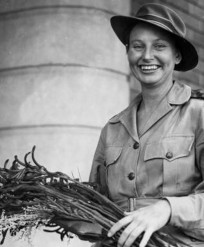
| Rank | Lieutenant Colonel |
| Service Number | VFX61330 |
| Unit | 2/13th Australian General Hospital |
| Cause of Death | Natural Causes |
| Place of Death | – |
| Date of Death | 3 July 2000 |
| Age | 84 |
Sole Survivor of a Massacre
After a bullet from a Japanese machine gun tore through her body, Australian nurse Vivian Bullwinkel floated face down in the sea and feigned death. She was the sole survivor of the 1942 Bangka Island Massacre, in which 22 nurses were forced to wade into the ocean at gunpoint and then shot in the back.
Early Years
Vivian was born on 18 December 1915 at Kapunda, South Australia. After her family moved to Broken Hill, in New South Wales, Vivian attended Broken Hill High School and was school captain in 1933. After completing school, Vivian trained as a nurse at Broken Hill Hospital and then continued her career in Victoria. She volunteered for service in 1941, joining the Australian Army Nursing Service.
“I felt if my friends were willing to go and fight for their country, then they deserved the best care we could give them,” she said in a later interview.
War Service
Assigned to the 2/13th Australian General Hospital, Vivian set sail for Singapore on the AHS Wanganella. After a few weeks with the 2/10th AGH, Vivian rejoined the 2/13th in Johore Baharu, where she remained until Japanese troops began to work their way down the Malayan peninsula, at which time the 2/13th was evacuated to the relative safety of Singapore. As it became likely that Singapore too would fall into Japanese hands, the nurses were ordered to leave. Vivian was in the last group of 65 Australian nurses to leave Singapore bound for Australia on the SS Vyner Brooke.
Evacuation from Singapore
The Vyner Brooke was a small ship designed to carry only 12 passengers; however, when it left Singapore 265 passengers were aboard. The Vyner Brooke travelled along, hugging the coast of the islands. On 14 February 1942 Japanese aircraft bombed the ship. It began to sink. The nurses assisted passengers to evacuate. Over the next three days, some would drown, some would drift ashore on life rafts and others would make it to shore in various locations on Bangka Island. Vivian joined the group on Radji Beach. There were men, women and children on the beach. The nurses cared for the sick and injured and remained with them. A decision was made to give themselves up, so a group of men walked into Muntok to do just that.

The Massacre
When the men returned with Japanese soldiers they could not have know what would happen next. All the men were ordered around a bluff where they were bayoneted and shot. The Japanese soldiers returned and ordered the nurses to walk into the water whereupon they were machine-gunned. As they marched into the sea, Irene Drummond called to her sisters “Chin up girls, I am proud of you. I love you all.” All of them fell, but one would not die. Vivian Bullwinkel would survive the massacre. She recalled that being shot was like being kicked by a mule and that she thought that being shot meant that you were dead. Floating in the water amidst the bodies of her friends she discovered that she was still alive. She feigned death until the Japanese had left the beach, then dragged herself up the beach, tended the gunshot wound as best she could, then took shelter in the jungle near a stream, where she fell asleep. Vivian was woken by a voice. It was Private Cecil Gordon Kinsley, a severely injured British soldier.
Twelve Days in the Jungle
Vivian found a water canteen, filled it with water from the stream for Private Kinsley. She dressed his wounds with what she could find. Finally she decided to seek help from the nearby villagers. The men of the village declined to assist her for fear of recrimination. The women of the village were more helpful and left her food on more than one occasion. Several days passed and they both decided to give themselves up to the Japanese. Private Kinsley requested one more day of freedom. When asked why, he told Vivian that it was his birthday and he wanted to spend the day in freedom. She agreed to his wishes. Vivian and Private Kinsley spent 12 days in the jungle.
Surrender
Vivian used the water canteen, slung over her shoulder to hide the bloodstained bullet hole in her uniform. They were walking towards Muntok, they were met by a car carrying a Japanese Naval officer, who drove them into Muntok where Vivian was reunited with 31 of her fellow nurses. Private Kinsley would die from his wounds a few days later.
Prisoner of War
Initially Vivian and the nurses were held in the Coolie Lines near the prison in Muntok. They then travelled to Palembang under horrendous conditions. After eighteen months in Irenelaan they would be sent by boat again back to Camp Menjelang in Muntok. The nurses lived under awful conditions. They had little food to eat and coupled with Beri-Beri, malaria, TB and Bangka fever, four more nurses would die in Muntok. The nurses were then sent back to Sumatra to Loebok Lingau to a camp called Belalau. A boat journey followed by a long train journey. Four more nurses would succumb to disease during their time in this camp.
Liberation
On the 16th of September 1945 the nurses would be liberated. On hearing this news, Matron Annie Sage and Sister Jean Floyd flew to Lahat, to greet the surviving Australian nurses, at the camp that was hidden in the jungle. Matron Annie Sage had lipsticks for all of the girls as she expected to find 65 nurses. Instead she was confronted with 24 painfully thin and unwell nurses. 24 women whose suffering had been unimaginable.
Return to Singapore and Home
The nurses returned to Singapore where they were treated for illnesses, and given time to recuperate from their malnutrition.
Having put on some weight, they were ready to be seen by the Australian public. They left Singapore on the 5th October 1945 on the AHS Manunda.
On their arrival back in Australia, they were greeted by many well-wishers offering fruit and bouquets. They still had so much to recover from though.

Home Again
Vivian and the other prisoner of war nurses were at home at last. What would the next chapter of their lives be like?
For Vivian it was letters and visits to the family of the murdered girls on Bangka Island. This was an amazing testimony to the woman that she was.
She was discharged from the Army in 1947, and was awarded the Royal Red Cross (2nd Class). She took some time to recover from the ordeal through which she had been as a prisoner of war. Vivian then commenced work at the Repatriation Hospital in Melbourne for a time.
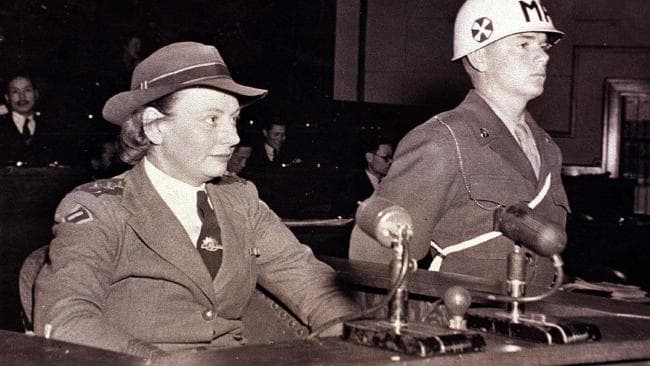
In 1947, Vivian travelled to Tokyo for the War Crimes Tribunal and stated her recollections of the massacre and subsequent treatment by the Japanese in the prisoner-of-war camps.
Conception of the Nurses Memorial Centre
Betty Jeffrey and Vivian Bullwinkel travelled around the state of Victoria talking about their experiences as POWs and how they were fundraising to support the establishment of a nurses’ memorial centre in memory of their fallen comrades. They didn’t want just a stone edifice to memorialise their fallen friends: they wanted a living memorial that would offer nurses a place to meet and a place that would support continuing education. They had thought about this concept when they were prisoners in Sumatra. On the 19th of February 1950 the establishment of the War Nurses Memorial Centre would become a reality.
Civilian Life
Vivian was appointed Matron of Fairfield Infectious Diseases Hospital in 1959. She was involved with many nursing related ventures that included the positions of President of the College of Nursing Australia and member of Council for the Australian War Memorial. She was an instrumental player in Operation Babylift where Vietnamese orphans we brought to Australia in 1975 by Australian nurses who cared for them in flight.
In September 1977 she married Colonel Francis (Frank) Statham and moved to Perth. She remained in touch with all of the ex-POW friends.

She continued to be an active voice for veterans throughout her life. Here she is on the left, marching with other military nurses in the 1955 Anzac Day parade in Melbourne.

Vivian was awarded both the Order of Australia and the MBE (Member of the Order of the British Empire) for her bravery.
Honours
Over the years Vivian received many awards. In 1947 she was awarded an ARRC (Associate of the Royal Red Cross), in 1973 an MBE (Member of the Order of the British Empire) and in 1993 an AO (Officer of the Order of Australia). She was also awarded the Florence Nightingale Medal and an Efficiency Decoration.
In 1993 she, along with seven of the other POW nurses, would travel back to Bangka Island, Indonesia to unveil the memorial to the nurses who had died there during the war and to those who had been prisoners of war.
Vivian died on the 3rd of July 2000 aged 84 years. Her service to Australia and to the nurses who died and were prisoners of war during World War II and to the nursing profession will never be forgotten.
This portrait in the Australian War Memorial depicts her wearing her grey nurse’s uniform, red cape and sister’s veil. Among her medals, she is wearing the Florence Nightingale Medal, the world’s highest honour available to nurses.

Vivian Bullwinkel AO MBE ARRC ED FNM FRCNA
On the 75th anniversary of the tragedy in February 2017, a commemorative coin bearing an image of the SS Vyner Brooke was struck by the Royal Australian Mint.
At that time, the director of the Australian War Memorial, Brendan Nelson, paid tribute to this outstanding heroine by saying this: “From a generation that produced so many remarkable Australians, Vivian Bullwinkel was a giant among them.”

In February 2023, the drill hall at Broken Hill High School was named in Vivian’s honour. The Vivian Bullwinkel Drill Hall is emblazoned with the year of Vivian’s captaincy of the school, 1933, and with a picture of Vivian in her AANS uniform.